
NASA’s ‘SunSketcher’ App Lets You Photograph The Eclipse To Unlock Sun’s Secrets
Image generated on AI
In many photographs and artistic renderings, the sun appears as a perfect sphere. And indeed, if you happen to glance at it briefly during the day (emphasis on “briefly”), that’s the impression you’d get. However, reality is more intriguing. Thanks to a phenomenon called oblateness, this hot ball of gas actually deviates from a simple spherical shape.
A new and free SunSketcher app, built by students and faculty at Western Kentucky University (WKU) and funded by NASA, harnesses your smartphone’s camera and GPS coordinates to record the total solar eclipse passing across much of North America on April 8. It’s available for both Android and iOS.
Leaning into the stellar power of citizen science, the project aims to gather a massive dataset of images focused on a specific phenomenon—Baily’s Beads.
Baily’s who-now? Well, Imagine a rotating spheroid. As it spins, centrifugal force generates inertia, causing it to slightly flatten, leaving behind an irregular, elliptical form. Earth, Jupiter, and Saturn—all display oblateness within our solar system. But the sun? It has its own unique characteristics affecting how it oblates.
Enter Baily’s Beads—tiny flashes of light observed during a total solar eclipse. These fleeting glimpses of light, caused by sunlight filtering through lunar valleys at the beginning and end of totality, hold valuable clues to the sun’s shape, or “oblateness.” As project lead Gordon Emslie explains, “The 2024 Eclipse offers an unprecedented opportunity to measure the shape of the Sun and so to infer its inner structure.”
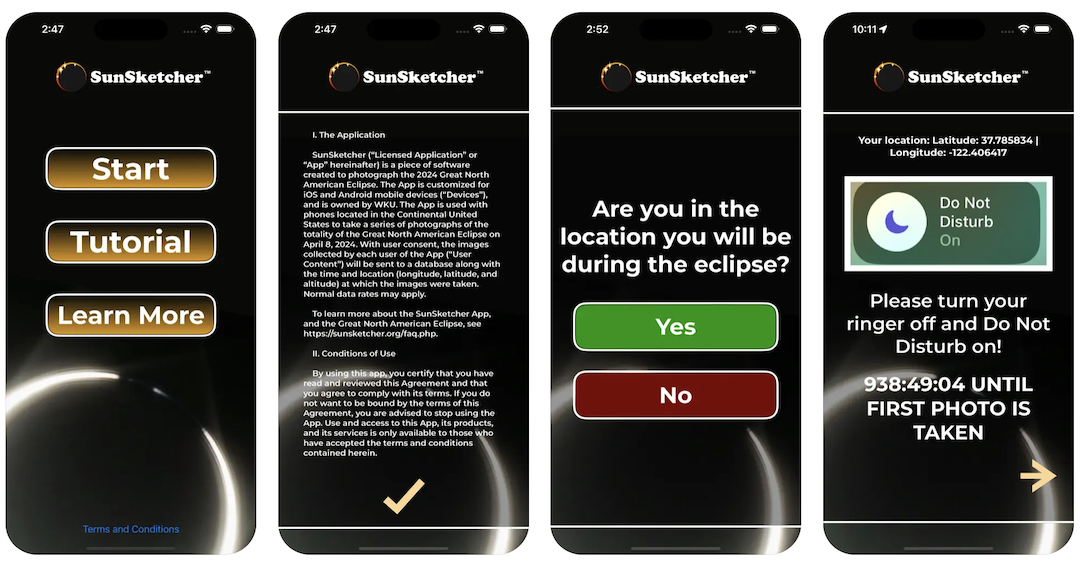
Screenshot via Western Kentucky University / Apple App Store
Traditionally, measuring the sun’s oblateness has been a complex endeavor requiring specialized equipment. SunSketcher, however, empowers everyday users to become citizen scientists. The app automatically captures images during totality, ensuring users don’t miss the crucial moments.
Once the eclipse has passed, participants can choose to upload their photos along with relevant details about their location and phone camera settings. This collective data will then be analyzed by researchers, contributing to a more precise understanding of the sun’s form and internal workings.
[via Popular Science, Hyperallergic, Simplemost, images via various sources]


